Research Paper


Abstract
References
Information
This study evaluates the effectiveness of Korea’s mandatory disposable cup deposit-return scheme, which was piloted in Sejong Special Self-Governing City and Jeju Province. Specifically, we ask: (1) Did the scheme reduce disposable-cup–related waste generation? and (2) Did it generate spillover effects on household waste generation? To our knowledge, this is the first study to provide quantitative evidence on the effectiveness of disposable cup regulation in Korea. We use panel data from the National Waste Generation and Treatment Statistics, covering both municipal solid waste and business-related municipal waste, for all local governments (si/gun/gu) nationwide from 2015 to 2023. The baseline empirical model is a difference-in-differences (DiD) design, with propensity score matching DiD (PSM-DiD) used as a robustness check. The results show that synthetic resin waste generated by businesses decreased by approximately 37% to 46% after policy implementation. This suggests that the deposit-return scheme produced statistically significant effects in reducing the use of synthetic resin products such as plastics and vinyl. In contrast, we find no statistically significant change in household waste generation, indicating no evidence of spillover effects at the household level.
이 연구에서는 정부가 시범적으로 세종특별자치시와 제주도를 대상으로 시행한 일회용컵 보증금제에 대한 정책 효과성을 분석하였다. 일회용컵 보증금제란 소비자가 음료를 구입할 때 사용한 일회용컵에 대해 일정 금액을 지불하고, 추후 이를 반납하면 보증금을 돌려받는 제도다. 연구 질문은 다음과 같다: 1)일회용컵 보증금 제도가 실질적으로 일회용컵 배출을 감소시켰는가? 2)이 제도로 인해 개별 가구에서의 폐기물 배출량 감소 효과가 발생했는가? 이 연구는 국내 일회용컵 규제의 효과성을 정량적으로 분석한 최초의 연구라는 점에서 학술적 의의를 가진다. 자료는 전국폐기물발생처리현황 통계를 활용했으며, 생활폐기물과 사업장생활폐기물을 분석 대상에 포함하였다. 분석 단위는 전국 지자체(시군구 단위)이며, 분석 기간은 2015년부터 가용한 최신 자료를 포함한 2023년까지이다. 분석 방법으로는 이중차분법을 기본 모형으로 하되 PSM-DiD를 활용하여 강건성을 검증하였다. 분석 결과, 정책 시행으로 사업장의 합성수지류 폐기물 발생량은 약 37∼46% 감소한 것으로 나타났다. 이는 제도 시행이 플라스틱과 비닐 등 합성수지류 사용 감소라는 정책 효과를 가져왔음을 시사한다. 한편, 가정에서의 합성수지류 배출량에는 유의미한 변화가 관측되지 않아, 정책 시행이 가정 부문에 파급효과를 유발하지는 않은 것으로 나타났다.
- 감사원, “1회용 컵 보증금제도 시행유예 관련 공익감사청구”, 「감사보고서」, 2023.8.
- 그린피스, 「2023 플라스틱 대한민국 2.0 – 플라스틱 소비의 늪에 빠지다」, 그린피스 동아시아 서울사무소, 2023.3.
- 김기원‧홍종호, “일회용컵 보증금 vs 부담금: 시뮬레이션을 통한 사회후생 비교”, 「환경정책」, 제33권 제5호, 2026, pp. 31~52. 10.15301/jepa.2026.33.5.31
- 김대진‧임재진, “1회용 컵 재활용 촉진을 위한 적정 보증금 추정에 관한 연구: 조건부가치추정법에 의한 지불의사액 추정을 중심으로”, 「규제연구」, 제31권 제1호, 2022, pp. 43~70.
- 김주한‧이우승, “일회용컵 보증제 시행 이후 프랜차이즈 카페의 방문수요 결정요인에 관한 연구”, 「한국외식산업학회지」, 2023, pp. 133~145.
- 이소라‧강수정‧권유림, “1회용 컵 자원순환 보증금제 도입을 위한 특징 분석 연구”, 「한국폐기물자원순환학회 심포지움」, 2022(1), p. 556.
- 정진영‧이희란, “일회용품 사용 규제 정책이 환경보호에 대한 대학생의 의식수준에 미치는 영향 연구”, 「한국생활과학회 학술대회논문집」, 2019, p. 64.
- 환경부, 「보도자료」, 2008~2024.
- Abadie, A., and G. W. Imbens, “Large Sample Properties of Matching Estimators for Average Treatment Effects,” Econometrica, Vol. 74, No. 1, 2006, pp. 235~267.
- Baumol, W. J., “Review of Deposit-Refund Systems: Theory and Applications to Environmental Conservation and Consumer Policy, by P. Bohm,” The Scandinavian Journal of Economics, Vol. 85, No. 3, 1983, pp. 437~439. 10.2307/3439604
- Bohm, P., Deposit-Refund Systems: Theory and Applications to Environmental, Conservation, and Consumer Policy, Baltimore, Johns Hopkins University Press, 1981.
- Calcott, P., and M. Walls, “Waste, Recycling, and ‘Design for Environment’: Roles for Markets and Policy Instruments,” Resource and Energy Economics, Vol. 27, No. 4, 2005, pp. 287~305. 10.1016/j.reseneeco.2005.02.001
- Caliendo, M., and S. Kopeinig, “Some Practical Guidance for the Implementation of Propensity Score Matching,” Journal of Economic Surveys, Vol. 22, No. 1, 2008, pp. 31~72. 10.1111/j.1467-6419.2007.00527.x
- Callaway, B., and P. H. Sant’Anna, “Difference-in-Differences with Multiple Time Periods,” Journal of Econometrics, Vol. 225, No. 2, 2021, pp. 200~230. 10.1016/j.jeconom.2020.12.001
- Card, D., and A. B. Krueger, “Minimum Wages and Employment: A Case Study of the Fast-Food Industry in New Jersey and Pennsylvania,” American Economic Review, Vol. 84, No. 4, 1994, pp. 772~793.
- Fullerton, D., and T. C. Kinnaman, “Garbage, Recycling, and Illicit Burning or Dumping,” Journal of Environmental Economics and Management, Vol. 29, No. 1, 1995, pp. 78~91. 10.1006/jeem.1995.1032
- Fullerton, D., and A. Wolverton, “Two Generalizations of a Deposit-Refund System,” American Economic Review, Vol. 90, No. 2, 2000, pp. 238~242. 10.1257/aer.90.2.238
- Heckman, J. J., H. Ichimura, and P. E. Todd, “Matching as an Econometric Evaluation Estimator: Evidence from Evaluating a Job Training Programme,” The Review of Economic Studies, Vol. 64, No. 4, 1997, pp. 605~654. 10.2307/2971733
- Laubinger, F., A. Brown, M. Dubois, and P. Börkey, “Deposit-Refund Systems and the Interplay with Additional Mandatory Extended Producer Responsibility Policies,” OECD Environment Working Papers, No. 208, 2022.
- Linderhof, V., F. H. Oosterhuis, P. J. Van Beukering, and H. Bartelings, “Effectiveness of Deposit-Refund Systems for Household Waste in the Netherlands: Applying a Partial Equilibrium Model,” Journal of Environmental Management, Vol. 232, 2019, pp. 842~850. 10.1016/j.jenvman.2018.11.102
- Lu, Z., L. Hasselström, G. Finnveden, and N. Johansson, “Cost-Benefit Analysis of Two Possible Deposit-Refund Systems for Reuse and Recycling of Plastic Packaging in Sweden,” Cleaner Waste Systems, Vol. 3, 2022, 100048.
- Marcus, M., and P. H. Sant’Anna, “The Role of Parallel Trends in Event Study Settings: An Application to Environmental Economics,” Journal of the Association of Environmental and Resource Economists, Vol. 8, No. 2, 2021, pp. 235~275. 10.1086/711509
- OECD, Global Plastics Outlook: Economic Drivers, Environmental Impacts and Policy Options, Paris, OECD Publishing, 2022.
- Picuno, C., S. Gerassimidou, W. You, O. Martin, and E. Iacovidou, “The Potential of Deposit Refund Systems in Closing the Plastic Beverage Bottle Loop: A Review,” Resources, Conservation and Recycling, Vol. 212, 2025, 107962. 10.1016/j.resconrec.2024.107962
- Roth, J., “Pretest with Caution: Event-Study Estimates after Testing for Parallel Trends,” American Economic Review: Insights, Vol. 4, No. 3, 2022, pp. 305~322. 10.1257/aeri.20210236
- Roth, J., P. H. Sant’Anna, A. Bilinski, and J. Poe, “What’s Trending in Difference-in-Differences? A Synthesis of the Recent Econometrics Literature,” Journal of Econometrics, Vol. 235, No. 2, 2023, pp. 2218~2244. 10.1016/j.jeconom.2023.03.008
- Schuyler, Q., B. D. Hardesty, T. J. Lawson, K. Opie, and C. Wilcox, “Economic Incentives Reduce Plastic Inputs to the Ocean,” Marine Policy, Vol. 96, 2018, pp. 250~255. 10.1016/j.marpol.2018.02.009
- Sun, L., and S. Abraham, “Estimating Dynamic Treatment Effects in Event Studies with Heterogeneous Treatment Effects,” Journal of Econometrics, Vol. 225, No. 2, 2021, pp. 175~199. 10.1016/j.jeconom.2020.09.006
- UNEP, Single-Use Plastics: A Roadmap for Sustainability (Rev. ed.), United Nations Environment Programme, 2018.
- Walls, M., “Deposit-Refund Systems in Practice and Theory,” in Encyclopedia of Energy, Natural Resource, and Environmental Economics, Vol. 3, 2013, pp. 133~137. 10.1016/B978-0-12-375067-9.00035-8
- Yizhe, Z., and 고준, “일회용 컵 보증금 제도의 친환경행동: 그림자노동, 지각된 효능감, 환경의식, 에코 죄책감을 중심으로,” 「한국IT서비스학회지」, 제22권 제5호, 2023, pp. 31~49.
- Zhou, G., Y. Gu, Y. Wu, Y. Gong, X. Mu, H. Han, and T. Chang, “A Systematic Review of the Deposit-Refund System for Beverage Packaging: Operating Mode, Key Parameter and Development Trend,” Journal of Cleaner Production, Vol. 251, 2020, 119660. 10.1016/j.jclepro.2019.119660
- Publisher :Environmental and Resource Economics Review
- Publisher(Ko) :자원 · 환경경제연구
- Journal Title :자원·환경경제연구
- Journal Title(Ko) :Environmental and Resource Economics Review
- Volume : 35
- No :2
- Pages :285-313
- DOI :https://doi.org/10.15266/KEREA.2026.35.2.285
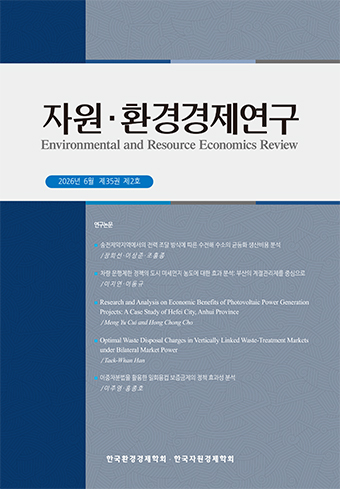 자원·환경경제연구